
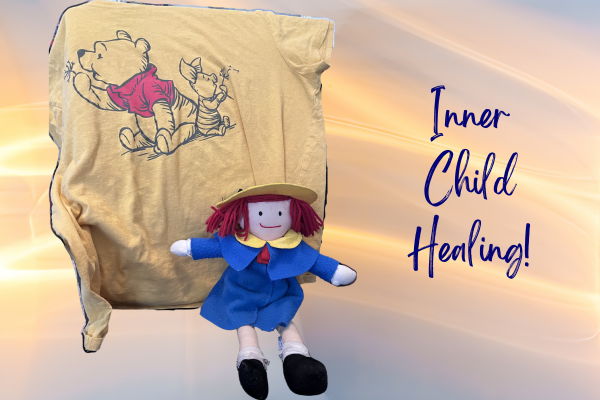
Photo credit to my adult daughter (who still loves her Winnie the Pooh shirt and Madeline doll)
Introduction
If you’re confused by what “inner child healing,” means, you’re not alone.
I first remember hearing about the inner child concept from John Bradshaw’s 1990 book, “Homecoming: Reclaiming and Championing Your Inner Child,” when I was in grad school. Alice Miller’s book on reparenting ourselves is another profound one: “The Truth Will Set You Free: Overcoming Emotional Blindness and Finding Your True Adult Self”
What is the “inner child?”
Essentially, the “inner child” is the idea that a younger version of ourselves remains within us regardless of our chronological age. This inner child holds all our childhood’s unmet needs, emotional wounds, and unconscious/core beliefs. Not only does this version of us remain with us as adults, but it impacts our adult functioning. The “inner child” is an incredibly validating, although also painful, part of healing.
Inner Child Healing
Inner child healing is essentially the process of “growing up” emotionally. It’s the act of reparenting ourselves or being the one we needed way back then. Healing the inner child is about nurturing, soothing and supporting ourselves now in ways we needed as a child but didn’t receive.
Because these ruptures occurred when we were young and our brains and bodies were still developing, we have difficulty describing the experience, or labeling the emotions. Some of these harms occurred before we had adequate language to understand them. Similarly, some of these patterns were set in place long before we had the pre-frontal brain structures to challenge them.
What is also sometimes confusing, is that our inner child doesn’t only hold our ruptures, but also our joy, playfulness, silliness and inherent creativity.
Signs of Inner Child Response
You might be wondering, “how do I know when I’m having ‘an inner child’ response versus having a wise-woman response?” GREAT question!
Here are 6 signals you’re likely responding from your inner child:
Big feelings to small events
When reactions seem ‘over the top’ or ‘out of proportion’ to a trivial action, you’re likely experiencing an inner child response.
Chronically Difficult Family Relationships
Family of origin tensions, being scapegoated in the family, feeling highly judged or criticized, or even experiencing emotional dependency on a parent can all create inner child experiences later in life.
Self-sabotaging behaviors
While the wise-woman part of you is ready for a challenge or a new opportunity your younger self remains deeply scared and anxious and actively avoids perceived dangers. This can show up as procrastination, perfectionism, forgetfulness, difficulty following through, even lying and ‘making excuses’ for not engaging in behavior your adult self desires.
Unhealthy Coping Skills
We are always coping – either consciously or unconsciously. Unhealthy coping skills are those that offer short-term relief without a long-term solution, such as substance use, overworking or excessive ‘busy-ness’, oversleeping or overeating, or dissociation through distractions like social media, gaming, or excessive exercise.
Relationship Issues
High conflict relationships (both stable and unstable) are also potential signal of inner child experiences. If you notice you’re experiencing familiar feelings and/or patterns from your childhood, be alert to how the childhood needs can be met in healthier ways.
Inner-critic/Poor Self-worth
Feeling persistently at fault, “wrong,” or engaging in excessively harsh or critical self-talk are all solid examples of childhood patterns showing up. Inner child healing helps you reconcile these experiences as an adult.
4 Pillars of Inner Child Healing – The Way “Back to Your Whole Self”
Because the inner child represents both the joys and the pains of childhood, the work of “healing the inner child” is varied and holistic. The skillset spans broad areas in our life but generally fall into four categories, or Pillars, of Inner Child Healing.
Pillar 1 – Self-Care
Self-care is the act of maintaining, caring for, and attending to matters of our emotional, physical, environmental and or financial life – to name a few. It’s how we truly look after ourselves as we go about life. This is not a rigid practice, but is flexible and adapts as our needs change. Self-care behaviors are taught and we often have many judgments about this area of life.
One major deficit in dysfunctional family living can be the lack of explicit ‘teaching’ of self-care skills. This might be due to caregivers who were overreactive to their own unresolved traumas and didn’t have the bandwidth to provide this instruction. Another deficit in this area includes excessive judgments about self-care such as being called lazy for resting, weak for slowing down, or selfish for recharging our emotional batteries.
Pillar 2 – Discipline
Discipline is one of the least understood aspects of inner child work because it was often misapplied in our childhood and our inner child may wholly rebel against this. In this context, discipline is the act of “self-discipline.” It involves consistently integrating simple but meaningful healthy habits and rituals to positively impact our lives. Because this area of inner child healing can be so important and triggering, it’s vital to go slow and create very small, sustainable changes so as to provide self-compassion and support when negative feelings arise.
Pillar 3 – Joy
Joy and whimsy are core elements of creativity, silliness, playfulness and curiosity that is inherent in all children. This is also typically snuffed out of us by humiliation, shame, or guilt-inducing treatment from caregivers or even society at large. This pillar of inner child healing teaches us to rediscover and reconnect to those areas of our youth that were playful and creative without any goal our outcome. Games, stories, art/drawing/coloring, jokes, dance, singing, etc. are all examples healing the inner child through joy.
Pillar 4 – Emotional Regulation
This aspect of inner child healing requires a good amount of self-awareness as to when we are experiencing an inner child trigger. If an emotional response is heightened, skills of self-validation, grounding skills, and mindfulness and somatic practices will help “ride the wave” as we return to baseline.
Activities for Inner Child Healing
- Writing “Unsendable” Letters/Journaling– letters to our younger self or to caregivers helps express feelings, validate, challenge the “seen not heard” culture, encourages standing in our own voice re: feelings, wants, desires.
- Creating Dialogue – learn loving and affirmative language for internal selfl-talk, nurture & support with self-compassion, create validating statements
- Art/Creativity – drawing, coloring, singing, sculpting, dancing, painting, etc. just for the sake of creating it are all ways to express the creativity that was once a natural part of us
- Playful activities – board games, active games like hopscotch, jacks, card games, playing tag or capture the flag, etc.
- Somatic Exercises – deep breathing, self-holds/massage, humming, rocking, yoga, walking, etc can all help activate our internal sense of safety.
- Visualizations and Guided Imageries – visiting the younger self, imagining an interaction or expressing comfort to them, having a dialogue with the younger self, etc. All of these help the inner child feel seen, heard, and comforted in necessary ways.
If you want some resources for inner child healing, you can start by download this training I did for free: Kairos Inner Child Training.pdf
Conclusion
Inner child work allows us to revisit and heal the wounds of our past. By acknowledging and addressing the unmet needs and emotional wounds, we remind ourselves we aren’t wrong or bad for having big feelings. We can heal the shame that was given to us for ‘being human,’ and release emotional burdens, foster self-compassion, and promote healing and growth.
If you’re interested in receiving support along this inner child healing path, visit my Work With Me page for more information.
0 Comments